
FutureSheLeaders (20)
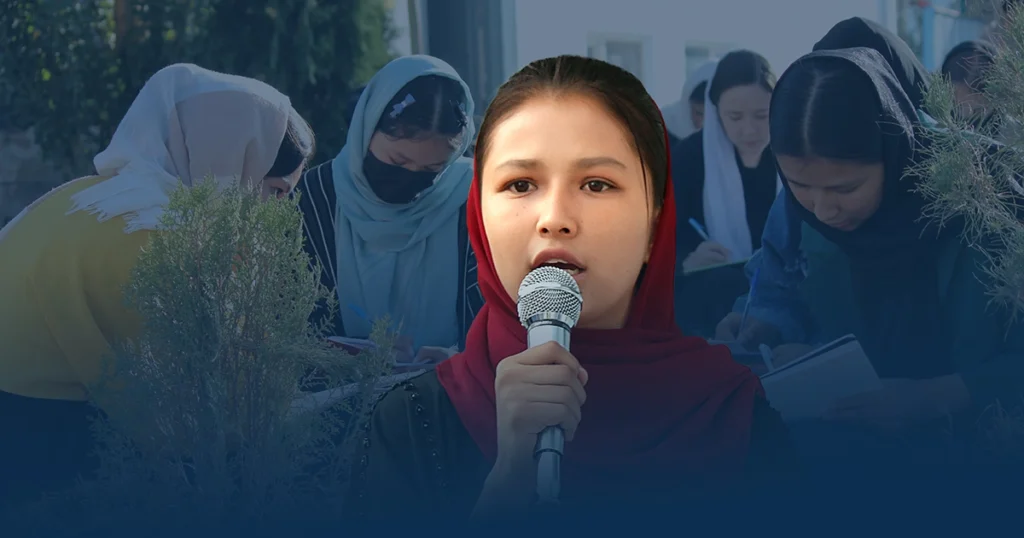
This week’s story is about Shakila Nazari – a girl who grew up with love, effort, and hope, and offered the meaning of her life in a single smile: half for her father, half for her mother.
Shakila was born in Afghanistan. Her father, through a patriarchal gaze, turned away from her and her four sisters. But in that shadow, her mother’s gentle wings spread wide – a mother who not only gave her daughter’s life, but also the strength to live it. Through learning and sports, they nurtured both their minds and their bodies, shaping themselves into strong, capable women.
In this story, Shakila takes us from her early school days to the Empowerment Sessions and the Peace on Earth Game, sharing a message of perseverance and self-belief.
In music, she found calm; in karate, she found strength; and in education, she found her drive to move forward. For her, every challenge was a chance to rise again – not just for herself, but for every girl searching for light in the dark.
Today, Shakila stands as a symbol of hope, love, and female leadership – a young woman who believes that peace, equality, and education can transform the world.
Her voice reminds us that strength is not the absence of pain, but the ability to smile, to love, and to keep walking toward the dream of a brighter tomorrow.
Let’s listen to this story with our hearts – and, together with Shakila’s smile, smile upon life itself.
Royesh: Welcome, dear Shakila, to Future She Leaders.
Shakila: Hello, teacher. Thank you so much for inviting me. I’m really happy to be here with you today.
Royesh: I’m sorry to hear that you recently lost a loved one. Who was it?
Shakila: Yes, that’s true. It was my grandmother. We’ve been busy with her funeral these past few days.
Royesh: I’m very sorry. What happened-how did she pass away?
Shakila: She had health problems. She used to smoke chillum a lot, and her lungs were completely damaged. Recently the family took her to Kabul for treatment, but all the doctors said there was nothing more they could do. So, heartbroken, they brought her back home… and three or four days later, she passed away.
Royesh: How old was she?
Shakila: Around ninety.
Royesh: She had lived a long life.
Shakila: Yes, she had.
Royesh: If we see this event only as a personal loss, it’s something that can never be replaced. But if we look at it as a lesson-as an empowerment exercise-we can think about two kinds of life: natural life and historical life. Your grandmother lived about ninety years-that was her natural life. But what about her historical life? What memory do you have of your grandmother from her historical life-from the life she lived and the mark she left behind?
Shakila: Teacher, I was very young when my grandmother came to Quetta once with my grandfather. I was about eight or nine years old then. Now I’m twenty, and after that one visit, I never saw them again. The only memory I have from my childhood is her small chillum pipe. She always kept it with her, wherever she went. That’s what stays in my mind. I haven’t seen my grandparents for the last twelve or thirteen years.
Royesh: What memories do you have of her? When you think of your grandmother-someone who lived ninety years in this world-what comes to your mind?
Shakila: I remember her kind words. She always told us, “Be strong like your mother.” She said my mother had always been a strong woman. Even when my grandmother was very weak and her voice was hard to hear over the phone, she would still say, “My daughters, be strong. You’re not weak, and you’re no different from boys.”
In our family, there were no sons-just five daughters. She always encouraged us, saying, “My daughters are no less than any boy.”
Royesh: You also mentioned your mother. Let’s continue this story as a kind of lesson. From your grandmother, you remember only one piece of advice-she told you to be like your mother. You might not remember her work or her life in detail, right?
Shakila: No, teacher.
Royesh: So, her natural life was ninety years-but her historical life, the life defined by her actions, might be less known. If even her granddaughter has no memories beyond that one advice, then for me-and for millions of others who never knew her-her presence may have left no trace. Now let’s turn to your mother-the woman your grandmother told you to be like. She seems very different.
Tell me about her. What’s her name? How old is she? What memories of her do you carry?
Shakila: My mother’s name is Mah-Gul. She’s about forty-nine or fifty years old. She came to Quetta because of illness, and it’s been about twenty or twenty-five years since she’s been living here. Life in Afghanistan was very hard for her. She became seriously sick there, and doctors said she couldn’t be treated inside the country-they advised taking her to Quetta or somewhere in Pakistan for treatment.
After that, my father decided to leave Afghanistan. His family was very traditional and patriarchal, so it wasn’t easy. But with my grandparents’ permission, my parents finally took the hard road of migration and came to Pakistan.
My mother’s illness lasted about two or three years. She was taken from one doctor to another, from one hospital to the next, until she began to recover. The doctors warned her not to do any heavy work again, as it could harm her health.
So, they stayed here in Quetta, and my father went to Iran to work. He stayed there for about seven or eight years. During all that time, my mother lived here alone with my oldest sister, Aziza-we also call her Shirin.
According to my mother, when they first came here, there were very few Hazaras in Quetta. Life was extremely difficult. For those seven or eight years that my father was away, they had no idea where he was or what had happened to him.
My mother worked tirelessly-doing embroidery and knitting to earn money. With that income, she sent my sister to school so she could study and even play sports. My sister also learned carpet weaving and later taught others. That’s how they lived and moved forward-through my mother’s hard work and her endless effort to support us and keep our education going.
One of my sisters often tells stories about how hard life was in the beginning. We went through so many struggles. But even in those difficult days, she kept going to school, learning English, and playing sports.
My mother always told us, “Each of you has the strength of five to ten sons. I may not have a boy, but my daughters are my sons. You must work hard to take that place for yourselves. Even if I don’t have a son, my daughters are my sons. Each of you should work hard enough to take that place for yourselves. There’s no difference between you and a boy. God gave you the same mind, the same intelligence. So try to be even stronger than them.”
That idea stayed in our minds: we are not less than boys. We lived like boys, acted like boys-our behavior, our attitude, everything. The only difference was our gender-we were girls, but our words and actions were just like boys.
We never felt we lacked anything. Thoughts like “I’m a girl, I can’t study” or “I’m a girl, I can’t play sports” never crossed our minds. Our mother always encouraged us, saying, “You are no less than any boy. If a boy can study and play sports, you can too. You are just as capable.”
During those years, my sisters Fatema and Aziza both trained in sports and made great progress. Because of my mother’s illness, she couldn’t return to Afghanistan. She stayed here in Quetta and raised us on her own. We all studied here, but life as refugees was extremely hard for her.
She often told us stories about those early days-how for three full years, she lived on a plastic sheet. She said, “We had no carpet, no dishes-nothing.”
Life was very tough. But with every bit of money she earned from embroidery and sewing, she slowly bought what we needed-first a rug, then a few bowls and cups-piece by piece, she built our home from nothing.
My sisters continued their sports and made great progress through their dedication. Even though we were refugees, they managed to get Pakistani B-Forms from some acquaintances so they could compete. My sister Aziza used the name Shirin and Fatema used the name Fereshta in the competitions. They worked hard for almost ten years in karate-training tirelessly and taking part in tournaments across different cities in Pakistan.
Each of them competed under those new names, representing not just themselves but all the girls who dreamed of such opportunities. Through those B-Forms, my sisters were able to progress a lot.
Once, there was an international tournament, and around ten girls from Pakistan were selected to travel abroad for the competition. My sisters were among them-but they couldn’t go because the documents weren’t in their real names. So they had to stay behind while the other girls went to Thailand, competed, and achieved great success.
At that time, as my sister said, there were very few girls in sports-maybe just ten or twelve training in that club. Despite all their hard work and progress, only my two sisters were left behind. They continued competing locally within Pakistan but never got the chance to represent their country abroad.
That dream stayed in their hearts, but it also left them discouraged. They said, “If we can’t move forward, how can we keep going?” So things remained that way-until my older sister got married and moved to Kabul.
Fatema also went with her to prepare for the university entrance exam (Kankor). In Kabul, they planned to start their own karate club-to continue the sport and train other girls. But before they could begin, Kabul fell, and they had to flee once again, returning to Pakistan. Their dreams were shattered-the dream of having their own club, of growing in karate, of representing their country abroad.
When they came back, my mother didn’t scold them. She just said, “It’s okay, my daughters. You’ll find another path. Afghanistan won’t stay like this forever. One day, we’ll rise again.”
After that, we stayed here and continued our lives. I was around eight or nine when I first started karate through my school. I trained for about a year and a half, but then I stopped.
My mother had told me, “If your sisters couldn’t progress in Pakistan, why should you keep trying? If it doesn’t lead anywhere, what’s the point of continuing?” So, I quit, and my sisters carried on for a while.
When Cluster Education offered a new opportunity, my sister became my coach again. That brought a new excitement into my heart-a voice telling me, “You should continue karate.” So, I started training once more, and it’s been about two to two and a half years now since I resumed my practice.
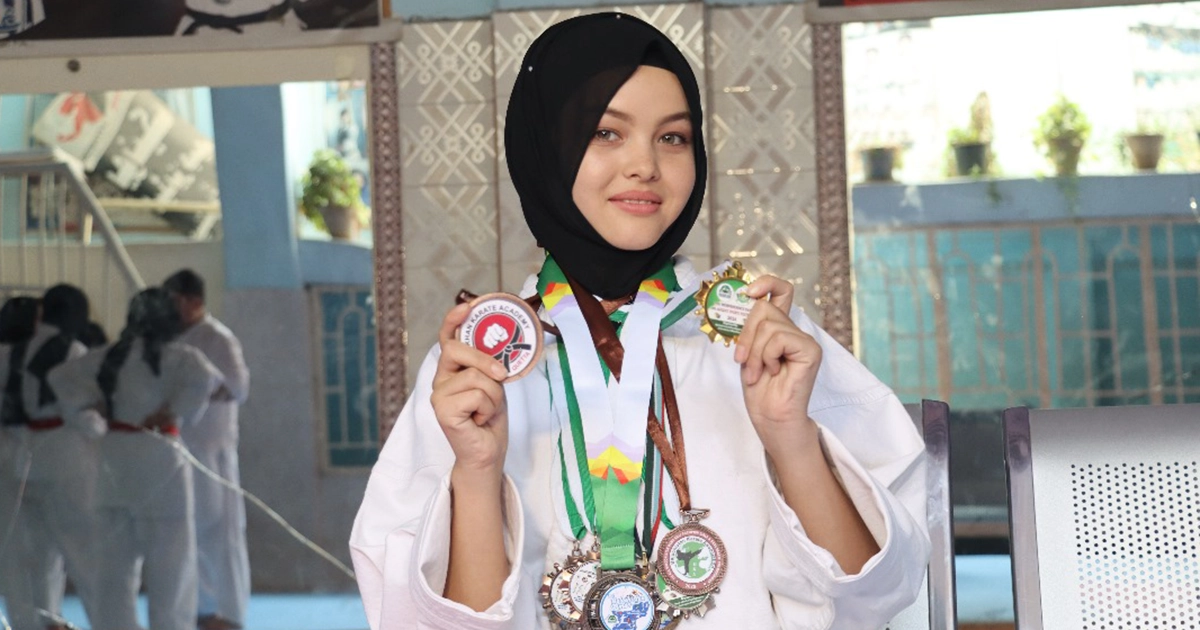
I’ve taken part in several competitions and even won medals. I’m really happy to be active in karate, and I truly love what I do. My biggest wish is for more girls to join us-so our group grows bigger and stronger every day.
Royesh: Shakila, the stories you’ve shared are deeply touching. We’ll revisit some of them later in this program. For now, I’d like to hear more about your mother. How long did her illness last, and how did she recover?
Shakila: My mother’s illness was very serious. Here in Quetta, she went from one doctor to another with my sister. Her treatment is still ongoing, and the symptoms remain. Every year or two, her illness flares up again. She still suffers from pain in her back and legs and often says, “I’m still not fully well.”
We continue to take her to doctors-even to Karachi, where people say the best doctors are-but despite all our efforts, she still hasn’t completely recovered.
Royesh: Tell me about your father. Where is he now? What kind of relationship do you have with him today? You’ve spoken beautifully about your mother’s courage and her influence on your life, but you haven’t mentioned your father yet.
Shakila: My father spent around seven or eight years in Iran. After that, he came to Pakistan and lived with us for a while, working here. He was very patriarchal-he always said, “Why don’t I have a son? What’s the use of daughters? What can girls do?” But my mother always stood behind us. She would say, “There’s no difference between sons and daughters. A child is a child, and we should be thankful for what we have.”
Still, my father insisted that he wanted to marry again so that he could have a son and “continue his bloodline.” Eventually, he went back to Afghanistan, and it’s been about three years since he left. He still hasn’t remarried, but he lives there now.
We have no contact with him. We don’t know what he’s doing or how he’s living, because he never calls us and never checks on us.
Royesh: Has your father remarried, or is he still single?
Shakila: No, he hasn’t remarried yet. He’s still living there in Afghanistan.
Royesh: And he doesn’t keep in touch with you?
Shakila: No, not at all.
Royesh: Does he send you any financial support?
Shakila: No, nothing. All the responsibility has always been on my mother’s shoulders. She raised all five of us by herself. After years of doing embroidery, she managed to save a little money and open a small shop. She’s been running that shop for about nine or ten years now. But in recent years, as her back and leg pain got worse, my sister took over her place at the shop while my mother stays at home.
Royesh: Tell me about your studies. Where did your education begin, and how has your academic journey continued?
Shakila: I studied at Esteqlal High School-from kindergarten all the way to grade twelve. I graduated from there, and that school is very dear to me. I’ve been walking those same hallways and streets for about fourteen or fifteen years-it feels like a part of me.
When I was in grade twelve, the Cluster Education program began. Our teachers encouraged us to join, to study more, and to learn empowerment. So I joined Cluster Education, and for about two and a half years, I studied there.
Through the program, I also took part in sports and in the Peace on Earth Game. We formed our own groups and carried out many activities together-it was a very inspiring experience.
Royesh: You were among the first group of girls when Cluster Education began at Esteqlal High School-the ones who started the program and experienced all the early empowerment sessions. Tell me more about your memories from Cluster Education. Especially about empowerment-since you had already seen the meaning of empowerment through your mother’s strength and your sisters’ courage, you had lived that experience in your own life. How did empowerment feel to you? Did you sense that what you were learning in those sessions was something you had already experienced in life?
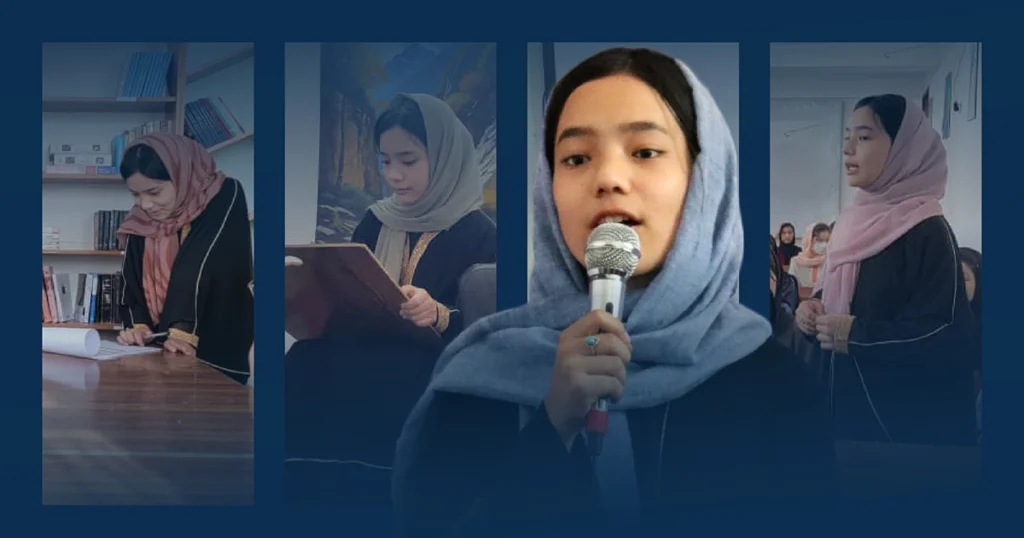
Shakila: When Cluster Education and the Empowerment program started, there were about ten of us girls who joined as the very first group. We attended the first Empowerment session and spoke in front of everyone. We prepared a lot for those classes-we wrote letters, essays, and reflections to share with you and with the guests who joined the sessions.
Empowerment was something very exciting and new for us. It taught us that before empowering others, we must first empower ourselves-and then help others do the same. That idea was completely new to me. Through Empowerment, we learned new lessons-the art of living. We discovered many things about ourselves: who we are, where we stand, where we’ve come from, and what we can and must do in our lives.
Royesh: The practical exercises in the Empowerment program took real shape when you formed your own groups. You were among those who started your activities from the very first days. Tell me about those experiences. When you formed your group, what kinds of things did you do-both inside the school and in the community?
Shakila: We formed a group of five friends, and later it grew to six members. We were a close team, even though our ages were quite different-one of us is 23, I’m 20, another is 19, two are 18, and one is 16. At first, there were five of us who started the group and began our activities.
We completed all seven actions of the Peace on Earth Game step by step. We started with Empowerment-learning how to empower ourselves first. Then we studied each action, practiced it, and created videos-both inside and outside the school.
We worked together on every lesson, recorded our experiences, and carried out the related activities with great excitement and teamwork. We also organized community activities. For example, we celebrated Father’s Day by buying small gifts and giving them to hardworking fathers. We celebrated different occasions together-the International Day of Peace, and the Hazara Cultural Day, among others.
Alongside these, we also founded the Kahkashan Literacy Center, which has now been running for two years. There, we teach women how to read and write. They are learning new things every day-basic literacy, writing, and reading skills-and it’s one of the most meaningful things we’ve ever done.
Royesh: We’ll look at your experiences in two parts: first, how you empowered yourself-through things like joining the music group, doing karate, and practicing within your empowerment team; and second, how you empowered others-by creating the Kahkashan group and teaching literacy to women in the community. Let’s start with the first part-music. How did you get into music? What did you learn from it, and how did your love for music begin?
Shakila: In Cluster, we had three main sections-football, karate, and music. I chose both karate and music. Music was something completely new for me. In the place where we live, women’s spaces are very limited, and there aren’t many girls whose voices are heard publicly. I thought, through karate, we empower our bodies-we become physically strong. But through music, we empower our souls-we let our voices be heard.
For me, music is the food of the soul. It brings happiness and makes a person better than before. I started music about a year and a half ago and continued my lessons regularly. I learned to play the harmonium, and we recorded several songs.
One of our first songs, “Ma Ra Digar Natarsan” (Don’t Scare Us Anymore), was actually broadcast-it was our debut piece. We kept going, working hard and training together, until the schools were shut down-and we had to stop.
Royesh: How many others are in your karate team? Your coach is your sister Fatema, right?
Shakila: Yes, she’s my coach. In our karate team, I’m the only member from the Kahkashan group. The other five members of our group are in football-they train together there. In karate, we had about forty girls training with us at one point. But later, the situation became difficult-conditions worsened, and families stopped allowing their daughters to go out because refugees were being pressured to leave. So, our numbers dropped. We ended up with only six or eight girls still training. Eventually, when the schools were closed, our sports section was also shut down.
Royesh: Tell me about your literacy program. How did you begin, and how much progress have you made? How many students do you have now?
Shakila: Our literacy program started about two years ago. In the beginning, we had only three or four students. We just sent members of our own team to teach them-basic reading and writing lessons.
We started small, with those three women, and now we have around 200 students. All of them have grown stronger and more confident compared to before. We’ve taught them how to read and write, and they’ve shared their stories with us-some painful, some full of hope. We inspire them, and they inspire us. It’s a beautiful exchange of strength and learning.
In our karate team, there used to be around forty girls training together. But then the situation here started to get worse-conditions became unsafe, and many families stopped allowing their daughters to go out.
Refugees were being forced to leave, and parents became very protective. They didn’t let their daughters go out alone or continue their sports. Because of that, our number of students dropped sharply. In the end, only about six to eight of us continued training. And finally, when the schools were closed, our sports section was also shut down completely.
Royesh: Besides teaching in the Kahkashan group, do you also tutor students privately-at home, for example?
Shakila: Yes, I teach basic English to some of my own students. I currently have nine of them. At first, I taught them at school, but when the schools closed, they started messaging and calling me, saying, “Please come to our home. We’ll bring a whiteboard and markers-just continue teaching us.” They told me they wanted to learn English and speak it fluently. So, for about a month now, I’ve been visiting their homes to teach them.
Royesh: Let’s return to something more personal now. When you were a little girl and saw your father leave the family, what did you feel-and how did you cope with it?
Shakila: I had mixed feelings-both good and bad. The good feeling came from thinking that maybe I wouldn’t hear any more arguments at home. I was young, and I thought, “Now there will be peace. Father won’t fight with Mother anymore.”
He often used to argue, saying things like, “You don’t have a son. What will you do with these girls? They should get married. What’s the use of studying or doing sports?” So, when he left, part of me felt relieved. But another part of me felt deep sadness. Losing a father is painful-it brings a feeling of loneliness, confusion, and fear about what would happen to us next. But then I told myself, “My mother has always been here-raising us, helping us, encouraging us-and she will continue to be here.” That thought gave me strength.
Royesh: You grew up in a family with two very different worlds-on one side, a father with a patriarchal mindset, as you described earlier, and on the other, a strong, woman-centered family led by your mother, who raised five daughters with the belief that girls are no less than boys and can do anything they want. How has this contrast shaped the way you see life-as Shakila?
Shakila: For me, it had a very deep impact. My mother always encouraged us, saying, “My daughter, if a boy can play sports, study, or speak English, you can too. You are no less than them. You can be as strong as any boy. You can play sports like a boy, study like a boy, and even become a teacher like one.”
Her words pushed me to grow stronger-to think higher. They motivated me to train harder, to study more, to stand on my own feet, and to become independent.
I always carried this thought in my mind: I must be a strong, confident, and independent woman-a girl who studies, works hard, and never gives up.
Royesh: On the other hand, when you look at your father-with his patriarchal attitude, saying things like “I don’t have a son, what use are daughters?” and then leaving your family-what kind of feelings did that create in you?
Shakila: It made me feel really bad. I kept asking myself, “What do we lack compared to boys? Why does he say, ‘You have only daughters-what will become of them? In the end, they’ll just get married and go to their husbands’ homes.’”
Those words bothered me deeply. I couldn’t understand why he spoke like that. I wondered, “Can’t we be like boys-study, become strong, and play sports too?”
That kind of thinking hurt me a lot and filled my mind with negative thoughts. But the more I thought about it, the harder I pushed myself-I trained more, studied more, and worked to prove that we can do everything boys can do, and maybe even more.
Royesh: Now, as a girl who has also studied Empowerment, let me ask you a more challenging question: Are you angry with your father? Do you resent him?
Shakila: No, not at all.
Royesh: Why not?
Shakila: Because I believe every person deserves to live the life that brings them peace. Maybe my father thought that without a son, his legacy would end. Maybe he feared that daughters couldn’t take care of him when he grew old-that he would be left alone. Those thoughts might have driven his decision. So, when he decided to leave and consider marrying again, we didn’t stop him. My mother and I even told him, “If you want to remarry and have a son, that’s okay-we don’t mind.” We weren’t angry; we just wanted him to be happy.
Royesh: Tell me about your sisters. In a family of five daughters, with your mother at the center-bearing both the weight of raising you and the pain of her illness-how is your relationship with one another? How do you support each other through such challenges?
Shakila: We are five sisters, each with our own personality. Right now, there are four of us living together-one of my sisters is not with us. My oldest sister, Fatema, is our karate coach. She spends most of her time outside the house, either working at our family shop or training others. Since the schools and sports clubs closed, she’s been focused mainly on the shop.
At home, it’s usually me, Zainab, and Sabera. I go to teach around 11 a.m. every day. Zainab leaves early in the morning for her literacy class, then goes to her music lessons. When she returns home, we all have lunch together. After that, Zainab and Sabera go to their painting class, while I stay home to prepare for my lessons or help around the house.
Our relationship is very warm and close. We often joke, laugh, and share ideas. When we feel sad, Zainab always lifts our spirits-she’s full of energy.
In one of our earlier videos, she cried while talking about something emotional, but that’s how she is-she can cry easily, yet she’s also the happiest among us. Sometimes she plays music, and we all dance together.
Zainab and Sabera, the two youngest, are inseparable-like twins. They study together, go to the same school, and do almost everything side by side. I’m the one in the middle-neither the oldest nor the youngest-so I often call myself the bridge between them.
Royesh: The connecting link!
Shakila: Yes!
Royesh: Sometimes you can act like the older sister, and sometimes like the younger one.
Shakila: Exactly.
Royesh: What challenges and opportunities has life in Quetta brought for a Hazara girl like you? What have you personally experienced?
Shakila: Life in Quetta has many challenges for a girl-especially for a Hazara girl. I’ve faced some of them myself, and my sisters have too, especially when they used to play sports. People often talked about us. They would say strange things like, “Why are girls doing sports? That’s not for girls!” Even some of our closest relatives would tell us, “You’re girls-why are you playing sports? Girls shouldn’t be doing that.”
But my mother always told my sisters, “Don’t care about what people say. Think of people’s mouths like the city gates-they’re always open. If you rise high and succeed, they’ll talk. If you fall behind, they’ll still talk. So just keep going.”
Despite all those challenges, my sisters and I continued. We trained harder, ignored the gossip, and focused on our goals. Yes, there were many difficulties-but there were also opportunities. Through those struggles, we found our strength. We were able to study, to play sports, and, fortunately, to complete our education.
Royesh: When you sisters talk among yourselves, do you ever feel that you’ve filled your father’s place in the family-standing beside your mother and supporting her?
Shakila: Yes, absolutely. There were many times-like during family gatherings or community events-when we really felt the absence of a man in our home. In our society, people often expect every family to have a man who speaks for them. At funerals, neighborhood meetings, or any formal occasion, people would say, “Someone from this family’s men should come and speak.” But there was no man in our house-only my mother. So, she would speak for all of us.
It gave us a strange but powerful feeling. Of course, we missed having a father, but at the same time, we were proud of our mother. She would say, “I’m like a man myself.” Her brothers always encouraged her. They would say, “You’re no different from a man-you’re as strong as any of them. In fact, most men can’t do what you’ve done.”
Royesh: These uncles of yours-the brothers of your mother-whom you mentioned earlier, are they still in touch with you? Do they live in Quetta?
Shakila: No, we don’t have any relatives here in Quetta. It’s just our family. We don’t have uncles, aunts, or any other close relatives living here.
Royesh: So when your uncles used to send those encouraging messages, was it through phone calls or other ways of staying in touch?
Shakila: Yes, both of my uncles used to call us often. One of them, my elder uncle, actually lived with us for a while here in Quetta. Later, he traveled to Iran-but sadly, on his way there, he passed away. We were told it might have been due to dehydration or some other problem on the road.
Now only my younger uncle is alive. He lives with my grandmother and takes care of her.
Royesh: And for you-as someone who is both a student and a teacher at the same time-how does that feel?
Shakila: It’s a really beautiful feeling for me. I’ve been both a learner and a teacher. I started teaching when I was in grade twelve. At first, I taught basic English to younger students in different courses, while also attending school myself. In the mornings, I was a student-and in the afternoons, I was a teacher.
Later, I continued teaching in the literacy program as well. It’s a wonderful balance: in the morning I learn new things, and in the afternoon I share what I’ve learned with others. That feeling-of being both a student and a teacher-gives me real joy and a sense of purpose.
Royesh: Empowerment means strengthening both the mind and the body. You experience mental empowerment through teaching-by empowering others-and physical empowerment through karate. When you compete, face an opponent, and test your strength, do you feel that sense of empowerment taking shape inside you?
Shakila: Yes, teacher, definitely. Every day I trained and learned something new, I could feel that sense of power growing inside me. Each time I learned a new technique, it made me more excited-it pushed me to work harder, to sweat more, to practice longer.
In my first competition, I entered the fight category. It was my very first tournament, and I lost my first match. There were so many participants, and my opponent was really strong.
In karate, matches are based on weight, not age or level-so even if you’re junior or senior, if your weights match, you fight. I lost the first fight, but the next day was the kata round, and I won. I placed third. That victory sparked something new inside me. I told myself, “Shakila, you can do better. Next time, aim for silver-or even gold.”
After that, I started training twice a day-morning and evening. I pushed myself hard, determined to improve. In our girls’ karate group-where my sister is the coach-there are about forty of us training together. Among them, my belt rank is one level higher. I have a green belt, while most of the others are in the red belt. It’s a small difference, but for me, it means a lot. It shows how much effort I’ve put in-how every drop of sweat has brought me a step forward. It makes me proud to say, “Yes, Shakila, you’re stronger than you were yesterday. Keep pushing yourself, keep growing, and keep moving forward.”
Royesh: In your competitions, do you usually compete only with girls, or have you ever faced boys as well?
Shakila: No, we only compete with girls. The boys and girls are separated. Boys fight with boys, and girls with girls.
Royesh: What do you think-if one day you were to face a boy in a match, could you do it?
Shakila: Yes, of course. The only difference between us and boys is gender. But when it comes to training, it’s the same. The same kata I perform, the same techniques I learn-boys learn them too. The real difference is in who trains harder, who sweats more, who practices more. That’s what makes someone stronger.
Royesh: Karate strengthens your body, but it also builds your confidence. How has this affected your sense of hope and optimism in life?
Shakila: It’s had a huge and beautiful impact on me. Every morning I woke up, went to my Cluster classes, and then to my karate sessions. Every new move or technique we learned gave me fresh energy.
Our instructor always encouraged us. He’d say, “Even though you girls started later than others, if you train harder and stay consistent, you’ll soon catch up-and one day, you’ll even surpass them.” That motivated us even more. Every class gave me new excitement and greater hope.
My biggest dream was to participate in bigger tournaments. But unfortunately, we could only compete within Balochistan. We saw other girls traveling to different cities across Pakistan, joining major competitions, winning medals, while we could only stay and compete here in Quetta.
Royesh: In martial arts, when you perform a kata, there’s often a shout-an expression of power, emotion, sometimes even anger. When you shout during practice, what do you feel most? Is it power, anger, or something else?
Shakila: Our instructor always tells us that when we shout-from deep inside-it’s not anger or hatred; it’s power. That loud kiai helps release all the fear and stress trapped in our bodies. He says, “The louder and stronger your voice, the more fear leaves your body.” So we work hard on our kiai, trying to make it louder and sharper each time. When we call out the names of our katas-like Heian Shodan or Heian Nidan-we shout them with strength and determination. That voice is a signal-it tells our opponent how strong we are. It’s not about anger; it’s about courage. When I shout, I feel fearless. My fear and tension disappear, and I can perform every move with full power and confidence.
Royesh: The power you feel-this energy you release through shouting and movement-could easily turn into anger, or even hatred, if not understood correctly. How do you make sure that your strength doesn’t fall from power into anger, and from anger into hatred?
Shakila: For me, this voice is pure power. In every competition I’ve entered, and in every practice I’ve done, it was never out of anger – never to feel above anyone or to prove I’ve trained more or know more than others.
For me, it’s always been about power – my own inner strength. Every time I shout louder, punch harder, or kick stronger, I feel I’m showing how powerful I’ve become – how much stronger I am than yesterday. It’s never been about anger. It’s always been about my power – the strength that comes from within me.
Royesh: Girls and women in Afghanistan – in the society you live in – you’ve also suffered a lot of unfairness because you are a girl. There’s a risk you might end up hating people of the opposite sex. When you feel power in your fists and your kicks, don’t you ever imagine someone standing in front of you and think, “If I get hold of them once, I’ll crush them with this punch, with this kick”?
Shakila: No, teacher – that never crossed my mind. Sometimes other girls tell stories like that: “Today I got into a fight and tried the moves I learned – in the street, in the market…”
To me, that sounds like showing off. Using what I learned in public, in front of people, feels foolish. What I learn from my coach I want to use for my own growth. I practice to improve myself, privately. I never think, “There’s someone in front of me – I’ll punch them so hard they fall unconscious.”
Royesh: One of the most important empowerment exercises is to make power yours – so power serves you, and you don’t become its slave. When power is under your control, it enables you; if it controls you, you lose yourself.
Many people who gain power fail to resolve that contradiction and end up doing harmful things. So, as a girl who practices karate: if you can resist the temptation that power brings, you are truly empowered – you control power. Do you really feel that you can restrain your power and not turn to hatred?
Shakila: Yes – I feel that inside me. Even if I grow stronger and make great progress, I would never lose myself. I can’t imagine a moment when I – Shakila – would be swept away by power.
Royesh: For example – using your power for revenge?
Shakila: No. I don’t need that. I wouldn’t use my strength to get even.
Royesh: If we present women’s leadership – the leadership you’re trying to build – as a model, what does power mean to you in that context? How would you use your power?
Shakila: I define power like this – when we train, when I as a girl practice and do sports, my confidence grows. My self-confidence rises, and I can defend myself and speak up. I shouldn’t be confined to the home like so many women. When I become strong, I speak with more confidence – the world can hear what I say and what’s in my heart. They will know who I am and what I do. I must keep working hard to show my strength to the world – who I am, where I come from, and what I can achieve.
Leadership asks a lot of you. You must earn people’s trust. You must be so strong and confident that others believe you know what you’re doing-and can teach them.
When I teach, I often have about thirty students in a class. They listen carefully and tell me, “We have a teacher – we learn something new.” In those moments I feel like a leader: everyone listens, practices, and follows the lessons closely.
Royesh: When you speak-to your students or to people in the neighborhood-do you ever feel your language gets stuck? Do you feel held back by your accent or lack of confidence, or are you comfortable?
Shakila: No, teacher – I’m comfortable now. At the beginning it was hard. The women in our literacy class came from many different families. In a class of thirty, that’s thirty families and thirty different ways of thinking. So we had to teach in a way that reached everyone. We worked to match our language to theirs – many of them speak Hazaragi. My Hazaragi wasn’t good at first, but after two years of teaching with them, my speech changed. Now I speak just like the mothers. When I sit and think, I can see how much my language has become like theirs.
Royesh: Have you seen girls hold back because they feel their language isn’t fluent? They stay silent-don’t tell their stories or share their experiences? Do you tell them, “Don’t be afraid-just speak. Your words are enough”?
Shakila: Yes. I taught class B; my students were very different. One of them was named Sharifa. One day we asked everyone to speak about their personal lives. We told each student: come to the board and try to say ten sentences. Even ten sentences would be a lot at first, but it would build their confidence. That day, each student stood up in turn and spoke from the heart. Some made mistakes, some spoke well-but we listened.
When it was Sharifa’s turn, she started to cry. She said, “Teacher, no one listens to me at home. When I speak, they treat me like a servant, not like a mother or the head of a family.”
She told us, “It hurts that my family never hears me. Today when you said, ‘I want to hear your voice – I want to hear what you have to say,’ that hurt me so much that I cried. You wanted to hear my voice. You wanted to hear what’s in my heart – something my family never listens to.
My heart aches so much for my family… but I’m also so happy you asked to hear me. That’s why she cried, and while she was crying she began to speak freely. I kept thinking about her afterward and I kept encouraging her.
You are not less than anyone. If no one in your family values you, then value yourself. Work on yourself – you are somebody. When you are a mother, you are a leader. Be strong enough so that people will listen. That day was very meaningful for me.
Royesh: Shakila, the story of your life – about yourself, your family, your mother, and your sisters – is full of inspiration. And that is exactly what leadership means: to guide, to inspire. Every person, in their individuality, carries something that can become a source of inspiration for others – something that tells them, you can do it, you can overcome obstacles, you can remove the barriers before you.
Now, if you were to turn your story into a message of hope – in your own words – for other girls, for those who are like you, what would you say to them?
Shakila: I would tell them that you can be like us too. Just as we overcame our challenges – living and progressing in a country deeply shaped by patriarchy, where women were so few – you can do it as well. Darkness has always been part of our lives, but it never lasts forever. We all pass through it and reach the light. One day, we’ll arrive at that light, at our goal, at our dream. I always imagine that day – the day I’ll celebrate, saying to myself, I made it; I reached my dream.
That’s my message to the girls of my country: you are strong. Yes, today you live in very difficult circumstances, but still – you can. You can strive, you can study, and you can reach your destination.
Royesh: Shakila, right now-or maybe later-two people might watch this video and listen to your story with the deepest attention and the most personal feeling. One is your father, and the other is your mother. Both would love to hear your judgment in your own voice.
Let’s start with your father. What would you like to say to him? As someone you feel is part of who you are, whose life continues through you-what message do you have for him now, with the memories you hold?
Shakila: My message to him is this: Dear Father, I kiss your hands from afar. You will always be my father, and that will never change. Even though you went far away from us to begin a new life, we are happy for you. We are truly happy that you are starting a new chapter, a new life.
Royesh: And what would you like to say to your mother?
Shakila: To my mother, I just want to say-I love you so much. I really do. And I want you to always keep encouraging me, just as you’ve done until now. Please keep supporting me in every part of my life, as you always have.
Royesh: If you were to offer a smile-a gift of your smile-to your parents, how would you divide it between them?
Shakila: If I had to divide it, I’d give it equally.
Royesh: Equally? Tell me-how would you divide it? What percentage would you give to your father, and what message would you attach to that smile? And what about your mother?
Shakila: Yes, equally. I’d divide my smile fifty-fifty. Both my parents are so dear to me-so close to my heart. I’d tell them that I love them both deeply and gift each of them fifty percent of my smile-with love.
Royesh: Now tell me-what is your dream for tomorrow? Imagine that twenty years from now, you are living in a world that you have built with your own hands-a world where your voice is heard, where people understand you and don’t judge you for being a woman. A world where your thoughts and your vision are seen simply as human. In that dream world, what do you want to do? What do you want to create?
Shakila: In my vision, I want our sports-especially karate-to grow and advance, to bring in new techniques and opportunities for us. I also want the voices of women-whether in so-called “Third World” countries like ours or in the developed world-to be heard equally. There shouldn’t be any difference between how we see men and women. We all should have equal rights and equal value.
I also dream of peace-peace across the world. We’ve set our goal for 2030, and by that time, I hope peace will fill our entire world. I dream of a free Afghanistan where all girls can go to school and university with smiles on their faces, where they can learn, grow, and play sports freely and happily.
Royesh: Thank you, Shakila. I’m truly happy that we could share your inspiring and meaningful story with your generation, adding another rich and beautiful chapter to the story of female leadership.
Shakila: Thank you, dear teacher, for always being there for us-and for giving your time today.






Comments (0)
Leave a Comment